


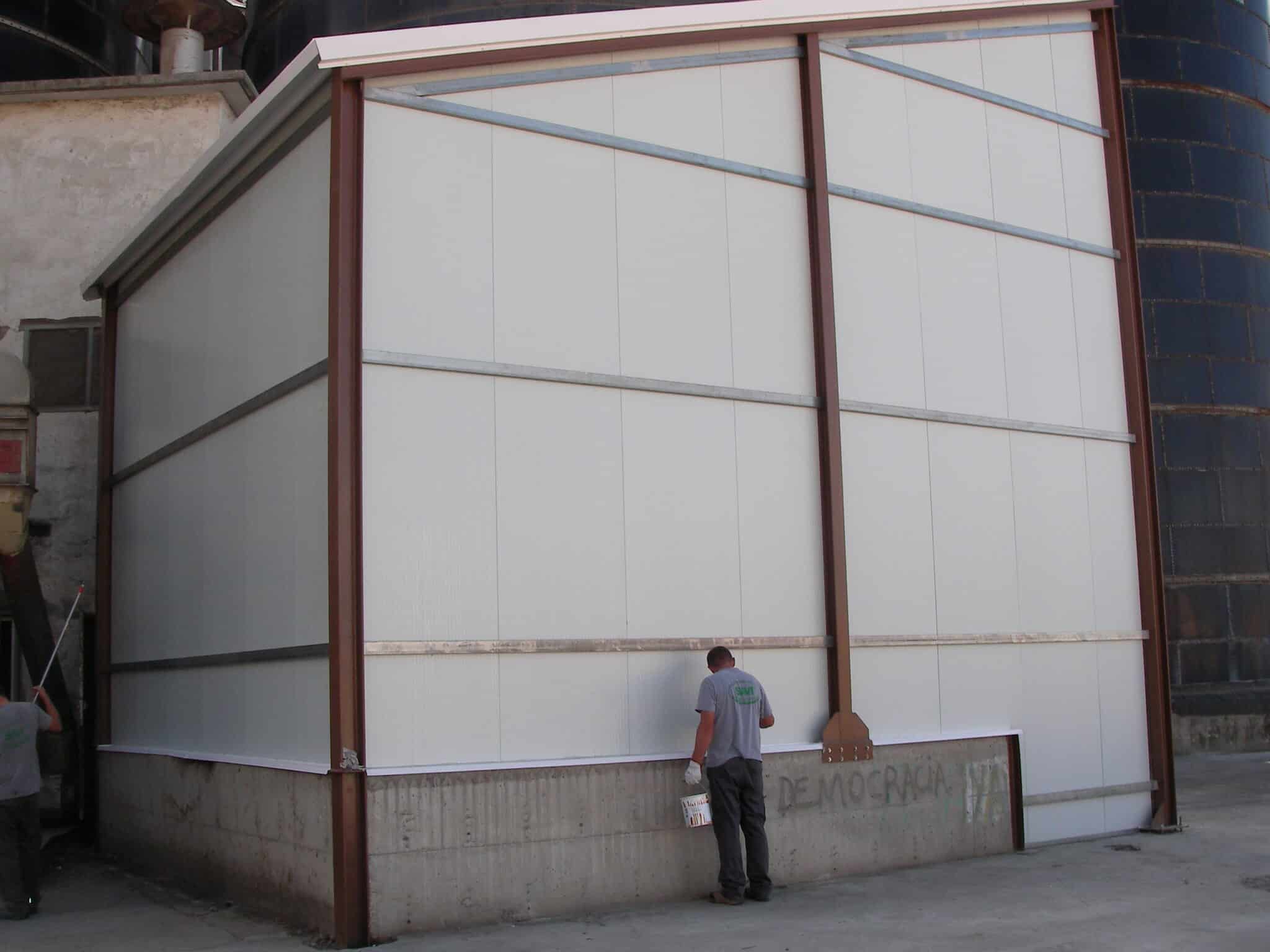
The facade sandwich panel is a prefabricated cladding system made up of two steel sheets and an insulating core of polyurethane (PUR), PIR or rock wool. In a single piece it resolves the enclosure, thermal insulation and exterior finish. Compared to traditional cladding, such as brick, mortar or wood, it is installed much faster, insulates better without adding layers and requires hardly any maintenance.
Looking for prices or specific models? You can find them all under facade sandwich panels.
It is not perfect for everything. With basic finishes it has a more industrial appearance, it withstands strong impacts less well than a masonry wall and, with a polyurethane core, it performs less well against fire and noise than with rock wool. Here you have the types of facade sandwich panel, their finishes, a comparison with traditional construction, their disadvantages and how to choose the right one for a warehouse or a home.
What is a Facade Sandwich Panel
It is a metal cladding system with integrated insulation. It consists of:
- Two galvanized and pre-coated steel sheets, with coatings that protect it from corrosion and UV rays.
- An insulating core of polyurethane (PUR), polyisocyanurate (PIR) or rock wool. There are also polystyrene cores.
- A joining system tongue-and-groove between panels, with visible or concealed fixing.
It is installed directly on metal or concrete structure. This way you get an insulated facade in a single operation. It is lightweight, but has notable rigidity, which allows covering wide spans between supports without complex auxiliary structures.
What problems it solves
- Thermal losses: a block, simple brick or simple sheet enclosure drives up air conditioning costs.
- Long lead times: traditional construction requires several layers and trades: structure, insulation, cladding and finish.
- Maintenance: moisture, corrosion and impacts deteriorate less resistant systems sooner.
Types of Facade Sandwich Panel
Visible Fasteners
It is the most used in industrial and logistics warehouses. The screws are visible, which facilitates assembly and reduces the overall cost. It is ideal for large surfaces. You can combine it with caps and seals to improve appearance and watertightness.
Concealed Fasteners
The fixings are hidden in the joint. The result is a clean and continuous facade, highly valued in commercial premises, offices and homes. In addition, the fixing is better protected from the weather.
Architectural Panel
Designed for projects where image is a priority. It accepts custom sizes, colors and finishes, and usually uses concealed fixing. It gives architects and designers a lot of freedom.
Finishes and colours
The facade panel is no longer just a functional solution. You can choose from:
- Smooth: minimalist and modern appearance, like the smooth facade sandwich panel.
- Micro-ribbed: provides a bit more resistance to the sheet and an elegant appearance. Widely used in commercial buildings.
- Colors to choose from: whites, grays, metallics or your company’s corporate color.
- Wood imitation: for a warmer and more natural appearance in homes, rural settings, porches or wineries. Check out the wood imitation facade panel.
If you opt for a natural wood finish on the exterior face, plan to apply glaze or varnish periodically. There are also models with the wood visible on the inside and the metal exterior face, which is the one that withstands the weather.
Advantages of Facade Sandwich Panel
- Continuous thermal insulation: the core forms a continuous barrier that reduces thermal bridges. You spend less on heating and air conditioning.
- Acoustic insulation: with a rock wool core, the panel blocks outside noise much better.
- Fast assembly: there is no wet work. The tongue-and-groove allows fast and precise assembly. The lead time is significantly reduced compared to masonry, in some cases up to half. That means fewer days of crane and labor.
- Durability: it withstands wind, rain and snow, and the coatings protect it from corrosion and moisture.
- Minimal maintenance: just clean the facade from time to time to extend its service life and preserve its appearance.
- Lightness: allows refurbishing old facades without overloading the structure and, often, without displacing the occupants.
- Aesthetic versatility: there are fixings, finishes and colors for almost any style.
Disadvantages and Limits of Facade Sandwich Panel
It is worth knowing them before deciding:
- Aesthetics: with a basic finish it has an industrial look. In restorations or classic-style buildings, traditional cladding usually fits better.
- Impacts: a brick or block wall has more mass and withstands strong impacts better than a sheet over insulation.
- Fire and noise, depending on the core: polyurethane and polystyrene are combustible and insulate less well from noise. PIR improves the fire performance of PUR. If the project requires fire resistance, such as in public-use buildings, you need rock wool.
- Depends on assembly: poorly sealed joints, poorly placed trims or inadequate fasteners cause leaks.
- Requires structure: the panel rests on a steel or concrete structure that must be planned for.
- Natural wood: if you choose this finish, it requires periodic treatments.
Sandwich Panel vs. Traditional Cladding: Comparison
By traditional cladding we mean brick, block, mortar or wood, systems that have been used for centuries.
| Criterion | Facade Sandwich Panel | Traditional Cladding |
|---|---|---|
| Thermal insulation | Integrated in the panel | Limited if insulation is not added |
| Construction time | Fast, in a single operation | Slow, several layers and trades |
| Total construction cost | Usually lower due to lead time and labor | Higher due to labor |
| Durability | High | High, depending on material |
| Impact resistance | Good | Very high in brick or block |
| Design | Many finishes and colors | Classic aesthetics, less customizable |
| Maintenance | Low | Medium or high (wood, mortar) |
When to Choose Sandwich Panel
When you are looking for a balance between efficiency, speed and cost. It is the logical choice in warehouses, storage facilities, commercial premises, offices, extensions, contemporary-design homes and energy refurbishments. And in any project where insulation is a priority.
When to Choose Traditional Cladding
In restorations, classic-style homes or settings where a metal finish does not fit. Bear in mind that, to match the insulation of the panel, you will have to add a separate insulation system.
Sandwich Panel on the Facade of a Home
It is increasingly used in homes, especially in modular construction. For a residential appearance, combine concealed fasteners with a smooth finish or wood imitation. It improves the energy efficiency of the house and provides a contemporary image.
It also works to renovate the facade of an existing house: due to its low weight, it improves insulation without overloading the structure. If you are looking for a complete industrialized home, check out casa-industrializada.com. In any case, review with your technician the project requirements, such as the required insulation or fire resistance.
How to Choose the Right Facade Panel
- Building use: in a warehouse, functionality and cost matter; in a shop, an office or a home, aesthetics.
- Core: polyurethane if you are looking for maximum thermal insulation; rock wool if you need acoustic insulation or fire protection.
- Climate and location: sun exposure and humidity determine the thickness of the insulation. In areas with high humidity, choose coatings with anti-corrosion protection.
- Fixing: visible if cost and speed are priorities; concealed if image is the priority.
- Finish and color: that fit with the building and its surroundings.
- Regulations: in public-use buildings, check the required fire resistance.
- Budget: compare the initial cost with the energy and maintenance savings in the long term.
| Core | Key Property | Recommended Use |
|---|---|---|
| Polyurethane (PUR/PIR) | Maximum thermal insulation with little thickness | Homes and industrial warehouses |
| Rock wool | Non-combustible and good acoustic insulator | Offices, public buildings and noisy areas |
If fire or noise are priorities, check out our rock wool sandwich panel.
Structure and Assembly: Key Details
The facade panel is fixed on a metal framework or on a concrete structure. The panels fit together with the tongue-and-groove and are fastened with specific screws. Then the joints are sealed and the trims are placed at corners, plinths, crown and around doors and windows.
Points that make the difference in the construction detail:
- Handle the panels without impacts or deformations.
- Use the specified fasteners for each panel.
- Seal joints and trims well to ensure watertightness.
- Complete the installation with the appropriate assembly accessories.
If you are wondering what an in-situ sandwich facade is: it is the one that is assembled layer by layer on site (inner sheet, insulation and outer sheet). The prefabricated sandwich panel arrives with everything joined from the factory and is installed in a single operation, which saves time. You have the step-by-step in our guide on how to install wall sandwich panels. And if you need the structure, at starmodul.com you will find custom bolted metal structures.
Frequently asked questions
Can You Install Sandwich Panel on the Facade of a Home?
Yes. With concealed fasteners and a smooth finish or wood imitation you get a residential appearance, and it improves the insulation of the house.
What Disadvantages Does Facade Sandwich Panel Have?
A more industrial appearance with basic finishes, less resistance to strong impacts than a masonry wall and, with a polyurethane core, worse fire and noise performance than rock wool.
Is Visible or Concealed Fastening Better?
Visible is faster and cheaper, ideal for warehouses. Concealed gives a clean facade and better protects the fixings; it fits in shops, offices and homes.
Which Core Insulates Better?
From cold and heat, polyurethane. From noise and fire, rock wool.
What Maintenance Does It Need?
Very little: periodic cleaning of the facade. If the finish is natural wood, also glaze or varnish from time to time.
Does It Work to Refurbish an Old Facade?
Yes. Being lightweight, it improves insulation and appearance without overloading the existing structure. First, a technician must check the support.
Are you going to enclose or renovate a facade? Request a quote or call us at 683 442 608. Tell us the dimensions and the use of the building and we will advise you on core, thickness, fixing and finish. We manufacture to measure, deliver on site with trims and screws and, if you want, we take care of the sandwich panel installation.