TECHNICAL GUIDE • SANDWICH PANEL
Sandwich Panel Technical Information
How a sandwich panel works, what its faces and core provide, how facade, roof, and cold storage solutions change, and what should be reviewed regarding insulation, airtightness, corrosion, fire, acoustics, durability, and recyclability.
This V4 retains and reorganizes the historical technical content of the section but clearly separates general data from values that must be verified in the technical data sheet, DoP, tests, or classifications of the specific product.
Technical Content of This Guide
Access the technical section you need directly. The main page summarizes the system’s behavior, and subpages develop each topic in more detail.
Evolution and Usefulness of Sandwich Panels
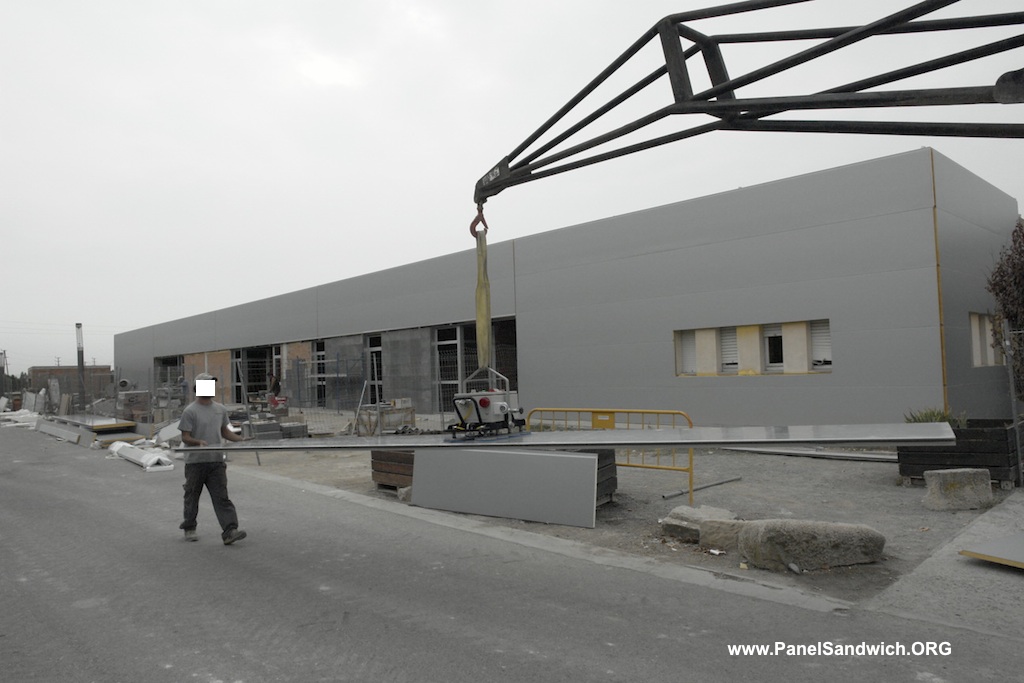
Composite panels or sandwich panels are used as external enclosures, partitions, facades, and roofs in industrial, commercial, and residential buildings. Their widespread use is explained by the combination of low weight, thermal insulation, and quick assembly, along with a wide variety of profiles, colors, coatings, hidden joints, and material combinations.
The original technical text for this section was written years ago: even then, it indicated that the system had been in use for over 30 years and presented the expansion of rock wool panels as an evolution from previous years. Today, rock wool is a consolidated family, especially when specific fire and/or acoustic performance is sought.
Basic Principles of the Sandwich Panel
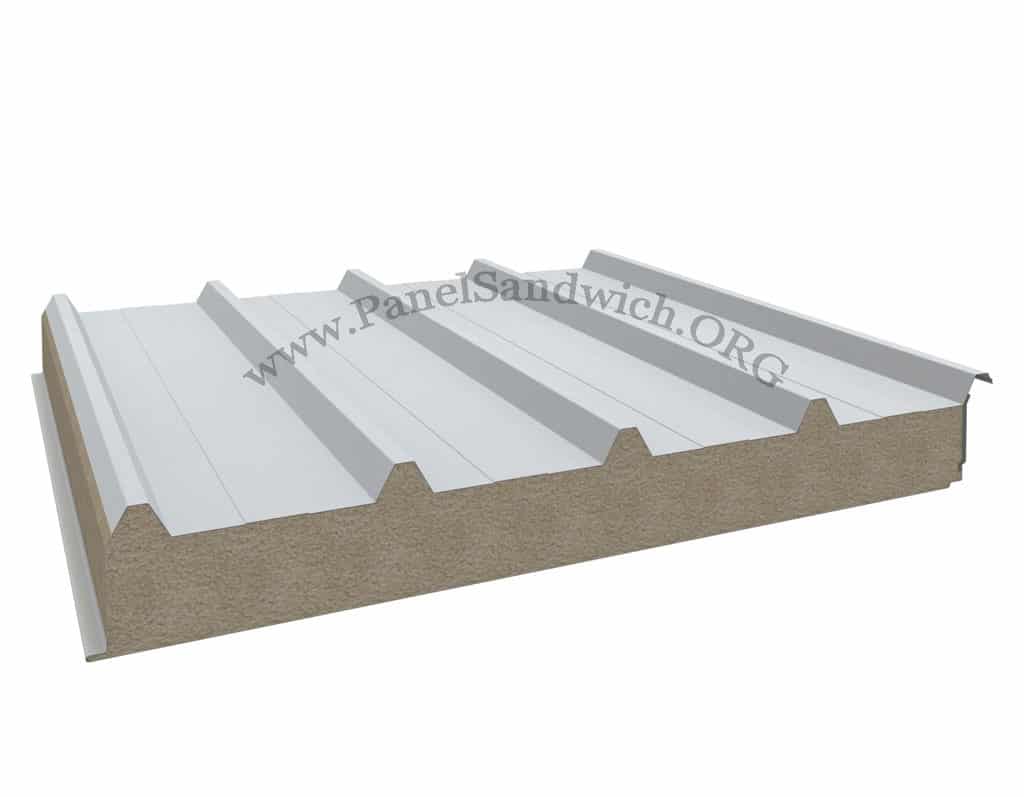
The basic configuration is always the same: two thin, resistant surfaces separated by a relatively thick and light core. The faces primarily handle stresses associated with bending, and the core maintains their separation, provides transverse rigidity, and transmits forces between them.
Combinations of steel or aluminum with PUR, PIR, mineral wool, or other cores allow the panel to be adjusted to the application. The final performance depends on the sum of faces, core, adhesion, joint, fixings, and connections.
What the Sheets Provide
- Mechanical capacity and surface rigidity.
- Protection of insulation against damage.
- Protection against atmospheric agents.
- Contribution to the vapor barrier when joints and connections are well resolved.
- Architectural finish, color, and texture.
What the Insulation Provides
- Thermal insulation.
- Separation between faces and transmission of shear forces.
- Contribution to acoustic performance.
- Interior protection according to system configuration.
How They Work Together
The faces and core must act as a single unit throughout the service life. The bond can be achieved through foaming, adhesives—common in mineral wool panels—or mechanical solutions depending on the system.
Technical Advantages of the System
- High strength-to-weight ratio.
- Continuous and durable thermal insulation when the system is correctly designed.
- Good barrier against water and vapor depending on joints and seals.
- High airtightness.
- Resistance of faces to weathering and aggressive environments depending on the coating.
- Fast installation, repair, or replacement.
- Repeatable industrial production and contained maintenance.
- Possibility of solutions with mineral wool for specific fire requirements.
Limitations that Must Also Be Considered
- Rigid foam cores are combustible; fire performance depends on the complete panel.
- Differential deformation can occur when one face is intensely heated, for example, by solar radiation.
- Foam cores may exhibit time-dependent deformation under load.
- The thermal capacity of lightweight enclosures is low compared to massive solutions.
- The acoustic insulation of a lightweight panel has limits inherent to low-mass constructions.
Facade, Roof, and Refrigeration Panels
The structural principle is common, but the geometry of the faces, joints, and fixings is adapted to the function of each enclosure.

Facade Panels
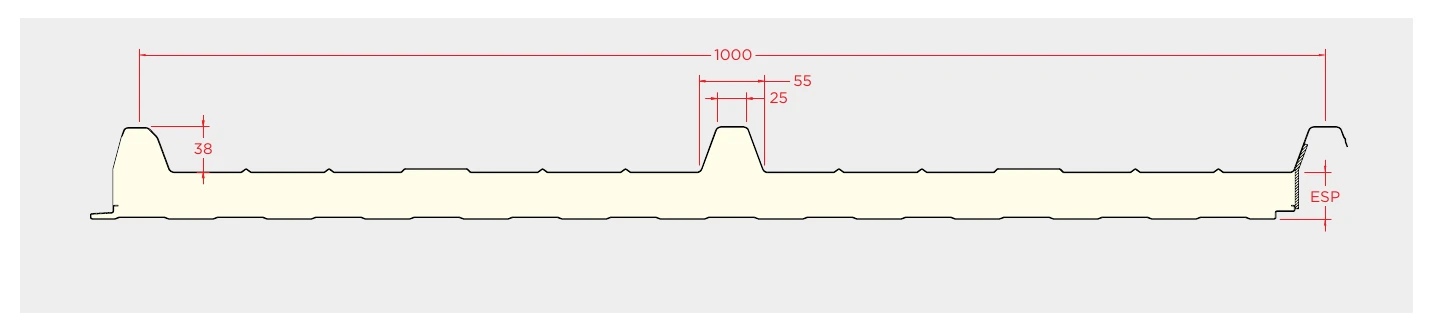
Metal faces are usually thin; the original technical content cites approximate typical thicknesses of 0.4 to 0.7 mm. Light ribbing, striations, or micro-ribbing are used to improve surface rigidity, control flatness, and create architectural effects.
- Tongue-and-groove joints or equivalents aim for tight connections between panels.
- Edges can be folded towards the core to limit thermal bridging between faces.
- A compressed sealant in the joint can contribute to water and air tightness.
Roof Panels
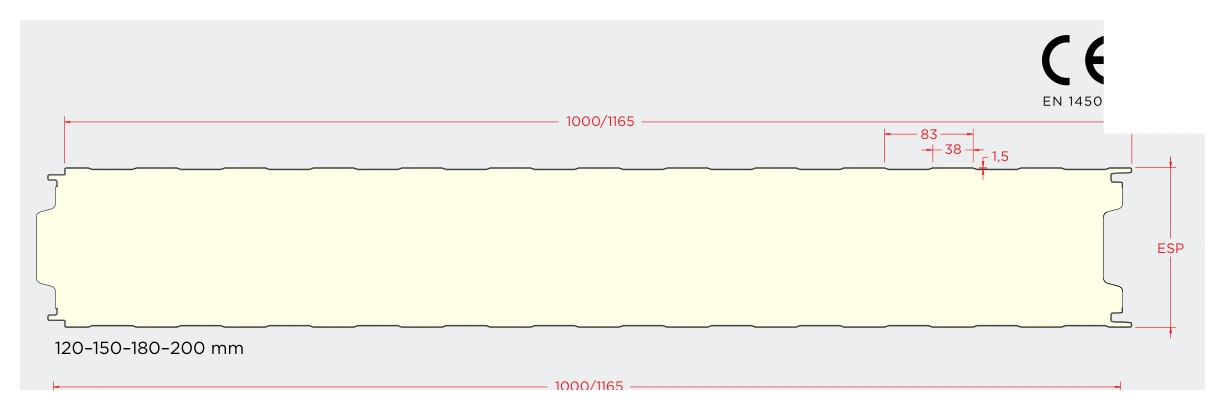
The geometry changes because during assembly and maintenance, human loads may exist, and in service, snow and rain loads. Therefore, the outer face is usually more profiled and may use sheet thicknesses greater than those for facades.
- Fixing with self-drilling or self-tapping screws depending on the system.
- The historical text describes fixing through the high zone of the rib and also solutions in the low zone with sealing washers.
- Self-closing joints with oblique geometry facilitate assembly and protection against moisture.
Refrigeration Panels
In cold rooms and warehouses, insulation thickness and joint continuity are especially critical. Connections must limit air and vapor entry and prevent thermal bridges.
- Thickness selection according to temperature and thermal design.
- Joints with special attention to air, vapor, and water.
- The original content describes the use of pre-formed sealants during assembly.
Functional requirements of the system
Correct specification is a balance between safety, performance, durability, aesthetics, construction, and cost. There is no single configuration that maximizes all properties simultaneously.
Security
- Stability during manufacturing.
- Transport and assembly.
- In-service use.
- Adequate fire performance.
Performance
- Resistance to water, snow, air, and dust.
- Thermal insulation.
- Condensation control.
- Acoustic performance.
Durability
- Weather resistance.
- Corrosive environments.
- Insulation stability.
- Adhesion durability.
Aesthetics
- Geometric tolerances.
- Flatness and profiling.
- Uniformity and color variation.
Construction
- Section suitable for the material.
- Fast and repeatable joints.
- Secure connections to the support.
- Viable transport and handling.
Protection Against Heat, Humidity, and Leaks
Thermal insulation is an essential part of the design of residential, industrial, public, and refrigeration buildings. In a real enclosure, the core value alone is not enough: infiltrations, joints, thermal bridges, and envelope continuity also play a role.
Metal faces and well-executed joints allow for an envelope with good air and water tightness. The historical content of the page indicated that adequate sealing systems could make the enclosure up to 100 times more airtight than certain modern reference enclosures. This data should be understood as a historical statement from the document and not as a universal value applicable to any current panel.
When correctly installed, panels can help reduce leaks, improve comfort, and decrease energy losses in both summer and winter. This same airtightness necessitates proper ventilation design: a very airtight building requires controlled air renewal for health, safety, and hygrothermal control, especially in humid climates.
Historical Comparison of Thermal Insulation
| Material | Thickness shown in historical comparison for equivalent thermal performance |
|---|---|
| Polyurethane foam | 5 cm |
| Polystyrene | 7.5 cm |
| Mineral wool | 9 cm |
| Cork | 10 cm |
| Chipboard / panel | 13 cm |
| Wood planks | 28 cm |
| Cement block | 76 cm |
| Brick block | 173 cm |
Atmospheric Agents and Corrosion
Protection against weathering and corrosion determines service life and maintenance. The combination of metallic coating, pre-treatment, and organic paint must be compatible with the interior and exterior environment.
The historical text noted that the anti-corrosion protection of metal faces had evolved to allow very long service lives—even exceeding one or two generations under favorable conditions. This should be interpreted as a general appreciation, not a guarantee of service life.
In marine environments or those with high salt concentration, the risk increases, and coating selection must be more demanding. The same applies to agricultural, industrial, or specific chemical agent installations.
Good practices for cutting, chip removal, damage repair, and metal compatibility are crucial to avoid compromising the protection system.
Fire Behavior
PUR / PIR
Rigid foams
These are combustible organic materials and can burn when exposed to a flame. However, the performance of the complete panel varies significantly with formulation, joint, faces, and configuration.
MINERAL WOOL
Mineral core
It is frequently used when the project prioritizes certain fire performance characteristics. Weight, thickness, thermal insulation, acoustics, and cost should also be considered.
CLASSIFICATION
Do Not Confuse Concepts
Reaction to fire and fire resistance are distinct performances. Classification must be taken from the tested system’s documentation and within its scope of application.

Acoustic Insulation and Absorption
Sandwich panels are used in factories and workshops where noise levels can be high. A smooth, hard metal face reflects a large part of sound energy; therefore, a conventional enclosure may offer insulation between spaces but little absorption within the enclosure.
To improve the acoustic environment, sound-absorbing materials are used on walls or ceilings. Panels with a mineral wool core and a perforated face can combine absorption and sound transmission reduction, for example, in partitions where a continuous vapor barrier is not necessary or in machinery enclosures.
Reducing the reverberant level inside a factory can also help meet external noise targets. The original content illustrated this function with road acoustic barriers.
Acoustic insulation
Describes the reduction of sound transmission between two spaces. Depends on mass, rigidity, core, joints, gaps, and indirect transmissions.
Sound absorption
Describes how much sound is absorbed within the enclosure instead of being reflected. A perforated face and an absorbent core can improve this function.
Energy Saving, Recycling, and Environmental Impact
The original technical content highlighted three ways to reduce impact: thermal insulation during the building’s life, enclosure durability, and material recovery at the end of its useful life. It also noted that low weight can reduce resources and transport loads compared to more massive solutions.
Some of the numbers that appeared in the original documentation are historical and should not be presented today as universal values. We retain them here because they are part of the existing technical information, but with their context:
The document also noted that aluminum can be recycled repeatedly and that metal and foam can be recovered or valorized at the end of the panel’s life. For a current environmental assessment, EPD data, environmental declarations, actual recycling rates, and current end-of-life scenarios for the product and country must be used.
Specific Technical Guides
General information is expanded across nine subpages. Each must retain all original technical data for its subject, reorganized and contextualized.
Frequently asked questions
It is a composite element consisting of two relatively thin and resistant faces separated by a lightweight core. The assembly works as a unit and combines mechanical function, protection, and insulation.
Geometry, loads, joints, and airtightness level change. Roof panels must address slope and loads on the roof; facade panels prioritize vertical enclosure; refrigeration panels require special thermal continuity and air and vapor control.
No. They have thermal, weight, acoustic, and fire performance differences. Comparison must be made with declared data of the complete panel, not just the core name.
No. They also provide mechanical capacity, surface rigidity, core protection, and part of the system’s airtightness and durability.
Yes. Reduced infiltration does not eliminate the need for air renewal. Ventilation must be planned in the design for health and humidity control.
No. They are retained as a technical reference and for content evolution. For calculation and specification, current data sheets, DoP, load tables, tests, and documentation of the specific product must be used.