
TECHNICAL INFORMATION · RAW MATERIALS
Sandwich panel materials: metal faces and insulating cores
A sandwich panel combines two rigid faces separated by a lightweight core. The faces provide protection, geometry, and load-bearing capacity; the core transmits shear stresses, keeps the faces separated, and provides most of the thermal insulation.
This guide preserves the historical technical information available on PanelSandwich.org, but explicitly separates old reference values from the performance levels that must be verified today in the technical data sheet and specific product documentation.
Why raw materials define the panel
The development of sandwich panels responds to the search for lightweight enclosures with high insulation and fast assembly. Rigid PUR/PIR foams allowed for reduced weight and thickness compared to traditional solutions, and the subsequent incorporation of mineral wool expanded options for fire resistance and acoustics.
Two rigid faces
The exterior surfaces are manufactured with relatively high-modulus materials and are kept separated by the core.
Lightweight core
The core provides stiffness to the assembly and supports a significant portion of the shear stresses between the faces.
Integrated insulation
The core functions simultaneously as an insulating material, allowing for lightweight and fast-to-assemble enclosures.
Metal faces: requirements and materials
The exterior metal faces are described in historical documentation as relatively thin, high-strength sheets. They must be capable of being roll formed and bent during manufacturing and, once incorporated into the panel, respond to different needs depending on the application.
- Resistance to wind actions.
- Impermeability to water and vapor when the system requires it.
- Contribution to panel strength and resistance to local loads.
- Compatibility with roll forming, bending, and continuous production processes.
- Adequate corrosion resistance and fire performance according to the system.
The original content cites galvanized steel, aluminum, stainless steel, and copper as the metals used. The sheets are usually supplied in coils, which allows them to be incorporated into continuous forming processes.
| Face material | Why it is used | Aspects of original technical content |
|---|---|---|
| Galvanized steel | Standard metal solution due to formability, strength, and economy. | Can be used painted or unpainted; coating and corrosion protection are specified according to the product. |
| Aluminum | Low weight and good corrosion resistance in certain applications. | Historical content cites 3003–3103 alloys and typical thicknesses of 0.7–1.2 mm in the applications described. |
| Stainless steel | Aggressive interior environments or high hygienic requirements. | Its corrosion resistance is related to chromium content and can reduce maintenance needs. |
| Copper | High durability finishes and natural formation of surface patina. | The original content relates patina evolution to marine, urban, or rural environments. |
Aluminum in sandwich panels
Aluminum: historical applications and thicknesses
The original page highlights the use of aluminum when there are special requirements for corrosion resistance or hygiene, for example in certain food production or storage environments.
As a historical reference, the text cites 3003–3103 series alloys and a typical thickness range of 0.7 to 1.2 mm. It also indicates that 0.7 mm was often considered a practical minimum to limit local damage from handling or foot traffic, although 0.6 mm could be used in certain cases.
Stainless steel, copper, and core adhesion
Stainless steel
The original content links it to applications with high hygienic demands or aggressive interior environments. The corrosion resistance of stainless steel is associated with chromium content and the formation of a protective passive layer.
Copper and patina formation
Copper is presented as a low-maintenance alternative. Its surface evolves through oxidation to form a protective patina, and the original color progressively darkens.
Historical documentation provides these indicative timeframes for full oxidation:
- 4–6 years: marine environments.
- 8–15 years: urban environments.
- 20–50 years: rural environments.
These are historical references and depend on actual environmental conditions.
Core adhesion and backcoat
To promote adhesion between the metal face and the core, the inner side may receive a specific primer. The original content cites an inner layer called backcoat with a reference thickness of 5 µm.
Rigid foam cores
The original technical documentation considers PUR/PIR and phenolic foam as the main rigid foams. They are described as thermoset materials with a predominantly closed-cell structure.
PUR / PIR
Rigid thermoset foams with mostly closed cells. The original content places approximately 90% of the structure as closed-cell.
- High thermal insulation
- Low thermal inertia
- Production through chemical reaction and expansion
Phenolic foam (PF)
Thermoset material historically described for its low conductivity and good ignition and smoke performance, but with greater mechanical fragility.
- Normally produced in slabs
- Subsequent bonding to faces using adhesive
- Greater care required against repeated loads
PUR and PIR: composition, reaction, and cellular structure
Main components
The formulation described for PUR/PIR is based on four main groups:
- Polyol.
- Isocyanate.
- Blowing agent.
- Activator or catalyst to control the reaction.
Blowing agents
Historical documentation recalls the phase-out of CFCs due to their impact on the ozone layer and cites various forms of pentane and water-based systems, whose reaction with isocyanate generates CO₂, as alternatives used subsequently.
It also mentions the possibility of incorporating flame retardants in certain formulations, warning that their effect and smoke emissions must be evaluated on the specific formulation and tested product.
Reaction, expansion, and cooling
Once the components are mixed, the liquid begins to foam and expand rapidly. The original document cites an approximate interval of 3–6 minutes between mixing and hardening, depending on thickness and process.
The reaction is exothermic. For panels over 100 mm, the historical text indicates that the core could locally exceed 150°C during the reaction and recommended a minimum period of 24 hours before shipping to complete hardening and cooling.
Historical chemical difference between PUR and PIR
The original content explains the difference through a higher proportion of isocyanate in PIR and cites, as a historical example, approximate polyol:isocyanate ratios of 100:100 for PUR and 100:150 for PIR.
It also relates PIR to greater thermal stability and the formation of a more stable charred layer when heated. As references from the original text, degradation processes above approximately 250°C for PUR and 350°C for PIR are cited, along with a PIR process temperature in the range of 40–45°C.
Cellular structure
The hardened foam is described as a network of closed cells separated by thin membranes. The cells contain blowing agent and reaction gases; the internal composition can evolve through diffusion over time, which influences thermal properties.
Historical classifications of PUR foams
B2/B3 and M2 classifications: preserve as historical context, not as current criteria
The original page describes the German DIN 4102-1 classification, where certain PUR foams were identified as B2 or B3, and also cites the French M2 classification linked to old approval procedures.
This terminology is maintained here because it is part of the historical technical content and helps interpret old documentation, but it must not be used to replace the current European classification of the finished product.
Phenolic foam (PF)
Rigid phenolic foam was historically incorporated into composite panels due to its combination of low thermal conductivity and good fire performance.
The original text attributes to it:
- High resistance to ignition.
- Reduced combustion speed compared to other described foams.
- Low smoke emission rates in the reference formulations.
Its production is described from a phenolic/formaldehyde resin, a volatile blowing agent, and a hardening agent. The foam was preferably manufactured in slabs, which were subsequently cut and bonded to the metal faces.
The documentation also points out two historical limitations: presence of residual acidic water, which hindered continuous lamination, and greater friability, relevant in roofs or ceilings subjected to repeated loads or foot traffic.
Historical properties of rigid foams
Density influences numerous mechanical properties of the foam and also the material cost. The industrial goal is to obtain the necessary performance without unnecessarily increasing the amount of material.
Heat flow through a rigid closed-cell foam depends largely on the gases contained in the cellular structure. Therefore, the blowing agent, composition, and thermal aging influence conductivity.
| Historical property | PUR B2 | PUR B3 | PIR | Interpretation |
|---|---|---|---|---|
| Reference density | 40 ± 4 kg/m³ | 38 ± 4 kg/m³ | 45 ± 5 kg/m³ | Values cited for products from a historical manufacturer; they do not represent all current panels. |
| PUR conductivity after manufacturing | 0.020–0.024 W/m·K | Historical reference for the described PUR foam. | ||
| Long-term PUR conductivity | 0.024–0.030 W/m·K | The text relates the change to the evolution of gases in the cellular structure. | ||
Mineral wool: structure, glass wool, and rock wool
Glass wool
The original page describes the manufacture of glass wool slabs from a melt of quartz sand, soda ash, and lime, or from recycled glass. It also cites the TEL method, in which the melt is transformed into fibers through small openings and air action.
Historical content indicates that glass wool can contain a proportion of binding agent in the range of 4–15%, and that density and thickness can be modified by varying process parameters such as belt speed.
Orthotropic structure
Mineral wool slabs present a strongly directional structure. Long fibers tend to align with the manufacturing process, while short fibers adopt more random orientations. This anisotropy explains why mechanical properties change according to the load direction.
Binders contribute significantly to the stiffness and strength of the finished product.
Rock wool, humidity, and temperature
The original text attributes to rock-based mineral wool high resistance to high temperatures and a good response to humidity compared to the glass wool considered in the same source.
Being a fibrous material without a closed-cell structure, vapor diffusion and the presence of water must be treated differently than a rigid foam. The source indicates that absorption can be reduced by water-repellent additives.
Historical properties of mineral wool
The original source indicates that approximately 75% of the thermal flow in the analyzed mineral wool was related to convective and conductive phenomena linked to the air contained in its structure.
It also points out that, with low organic binder content, mineral fibers exhibit very low combustibility; however, the reaction to fire classification of a current product must be obtained from the complete panel documentation.
| Historical property of mineral wool | Range / cited value | Observation |
|---|---|---|
| Density used in panels | 90–145 kg/m³ | General range cited by the historical source. |
| Compression perpendicular to fibers | 0.005–0.08 N/mm² | Strength depends heavily on structure and density. |
| Tension perpendicular to fibers | 0.001–0.01 N/mm² | Lower than the strength parallel to the main orientation. |
| Shear strength | 0.03–0.20 N/mm² | Historical reference value. |
| Shear modulus | 2–20 N/mm² | Depends on orientation and internal structure. |
| Parallel tension | 0.03–1.0 N/mm² | With cited modulus of elasticity of 5–40 N/mm². |
| Parallel compression | 0.10–0.15 N/mm² | With cited modulus of elasticity of 6–20 N/mm². |
| Water absorption in composite panel | 0.2–0.5% | Historical reference for normal conditions and product protected by faces. |
| Slab thermal conductivity | 0.033–0.034 W/m·K | Historical source for approximate densities of 60–150 kg/m³. |
| Glass fiber melting temperature | ≈650°C | Does not equate to a panel fire classification. |
| Rock fiber melting temperature | ≈1000°C | Does not equate to a panel fire classification. |
Technical comparison of insulating cores
The comparison must be made by finished panel performance, not by a single property of the base material.
| Family | Structure | Main strength | What to check in project |
|---|---|---|---|
| PUR | Rigid closed-cell foam | Very good thermal insulation with reduced weight | Declared conductivity, density, reaction to fire, thickness, and panel U-value |
| PIR | Rigid foam with higher isocyanate index | Thermal insulation and better thermal stability than equivalent PUR formulations | Declared panel performance; do not extrapolate from the foam |
| PF | Thermoset phenolic foam | Historically noted for low conductivity and fire performance | Current availability, fragility, classification, and complete system |
| Rock wool | Mineral fibers with binders | Fire and acoustic performance in specific systems | Density, orientation, absorption, U-value, acoustics, and panel classification |
| Glass wool | Glass fibers with binders | Thermal and acoustic insulation in compatible systems | Binder content, density, humidity, and system classification |
What documentation and properties you should check today
Historical technical information is useful for understanding why materials behave differently, but the specification for a project must be supported by current product data.
Metal Faces
- Material and quality
- Nominal thickness
- Metallic coating
- Organic coating
- Interior and exterior finish
Core
- Type of insulation
- Density when declared
- Thermal conductivity
- Panel U-transmittance
- Product reaction to fire
Complete product
- Applicable standard/documentation
- Statement of Benefits
- Dimensions and tolerances
- Load tables
- Joint and fixing
Project
- Interior and exterior environment
- Corrosivity
- Required fire and acoustic performance
- Humidity and temperature
- Compatibility with flashings
Materials and finishes in real products
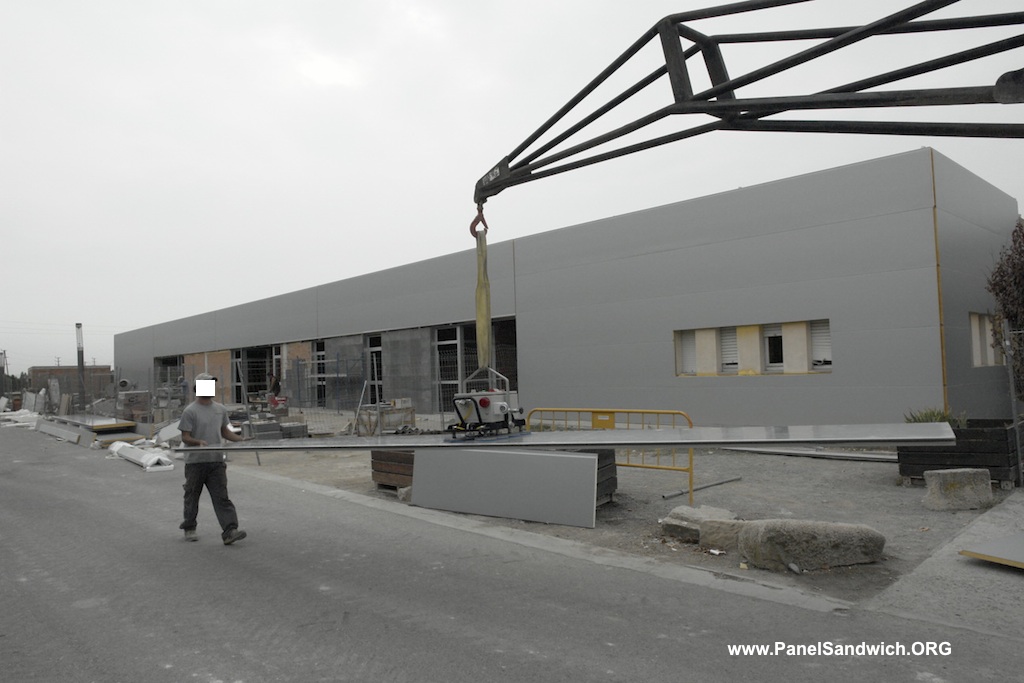
Metal Faces
The profile, thickness, and coating of the faces are part of the product specification.
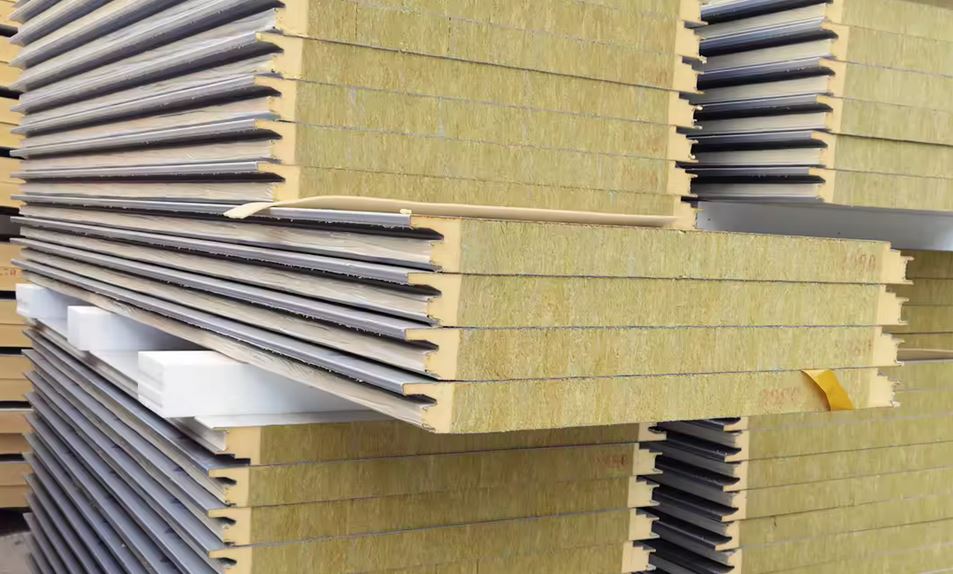
Mineral Wool
The fibrous structure and the orientation of the lamellas condition mechanical, thermal, and acoustic properties.
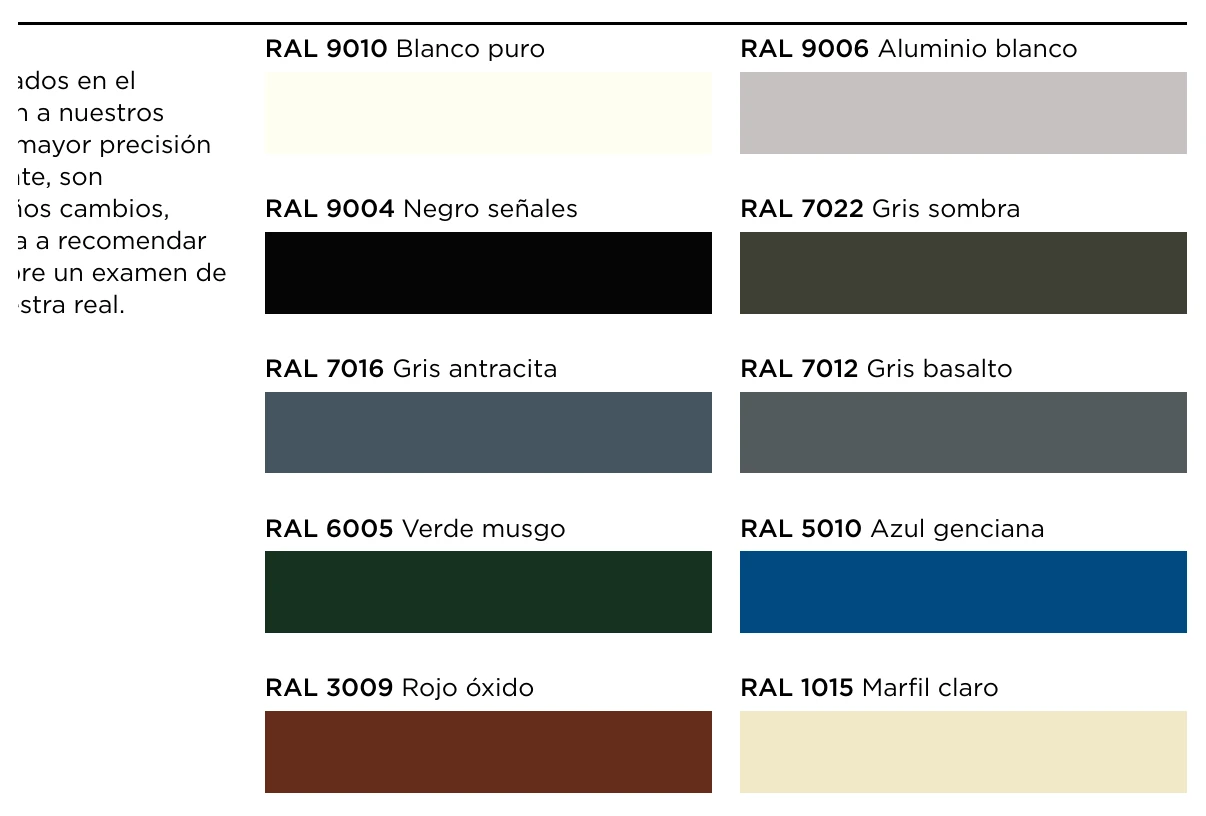
Coatings
Color is only one part of the system: underneath there is a combination of metallic protection, primer, and organic finish.
Continue with the technical guide
Raw materials explain the base behavior. The next step is to understand how they are transformed during manufacturing and how the metal faces are protected.
Frequently asked questions about sandwich panel materials
It usually combines two rigid faces—normally metallic—with an insulating core. The product family can use steel, aluminum, stainless steel, or other metals and cores such as PUR, PIR, or mineral wool, depending on the specific solution.
No. They are chemically related families, but PIR uses a formulation with a higher proportion of isocyanate and can exhibit different thermal and fire performance. The finished panel should be compared, not just the foam.
They are historical designations useful for interpreting old documentation. For a current product, the valid classification and documentation of the complete panel must be used.
No. The historical ranges on this page explain general behavior, but each panel uses a specific configuration. The product’s declared values must be reviewed.
No. Fire resistance or reaction is classified based on a product or system configuration. The melting temperature of a fiber does not replace that classification.
The inner side of the coil may incorporate a primer or coating designed to promote compatibility and adhesion with the core. The specific system depends on the manufacturer and process.


