Rain noise on a sandwich panel roof is caused by raindrops striking a lightweight steel sheet and making it vibrate. With a polyurethane panel, it is louder than under a heavy tile or concrete roof. There are three effective ways to reduce it: use an acoustic rock wool panel, add an insulated suspended ceiling underneath, or install a heavy finish on top. Choosing correctly from the start is much cheaper than fixing it later.
Why rain makes noise on sandwich panels
A sandwich panel consists of two steel sheets joined by an insulating core. When it rains, each drop is a small impact on the outer sheet. This impact makes the sheet vibrate, the vibration passes through the core to the inner sheet, and the inner sheet radiates the sound into the building.
How much noise is heard mainly depends on three factors:
- The mass of the roof. The heavier it is, the less it vibrates. A polyurethane panel weighs very little per square meter, which is why it is so easy to install, and also why it is noisier.
- The core. Polyurethane (PUR) and PIR insulate very well against heat, but they are rigid foams that transmit vibration. Rock wool is fibrous and much denser, so it dampens vibration better.
- What’s underneath. If the panel is left exposed inside, in an open-plan building, the sound bounces off the walls and reverberation amplifies it.
Rain noise is impact noise, different from airborne noise (traffic, voices). It is measured using a specific laboratory test that few manufacturers publish, so the most reliable way to compare panels is to look at their mass, their core, and the Rw sound insulation index shown on the datasheet.
Solutions to stop rain noise
1. Acoustic rock wool sandwich panel
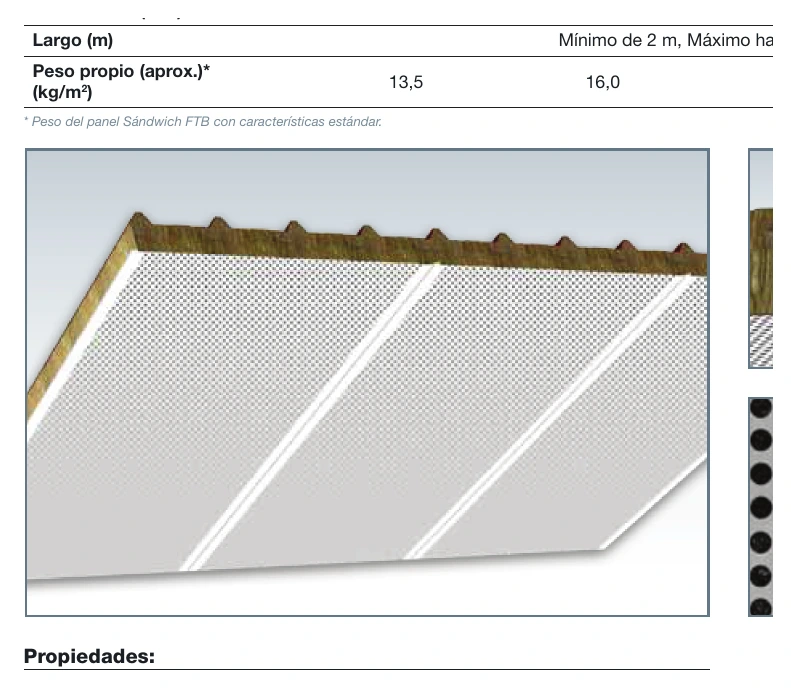
This is the most effective solution if you’re still choosing a panel. The rock wool core has a density of around 100 kg/m³, and the inner sheet is perforated, so the panel not only insulates but also absorbs sound inside the building. Our acoustic rock wool roofing panel has the following specifications:
| Thickness | Weight | Sound insulation Rw | Thermal transmittance U |
|---|---|---|---|
| 50 mm | 13.5 kg/m² | 34 dB | 0.71 W/m²K |
| 75 mm | 16.0 kg/m² | more than 34 dB | 0.50 W/m²K |
| 100 mm | 18.5 kg/m² | more than 34 dB | 0.39 W/m²K |
| 120 mm | 20.0 kg/m² | more than 34 dB | 0.33 W/m²K |
Its sound absorption coefficient is αw = 1.00 (Class A), which virtually eliminates interior echo. It is also non-combustible (A2-s1,d0). The trade-off: it weighs more than a polyurethane panel and, at the same thickness, insulates slightly less against heat, so it’s advisable to increase the thickness.
2. Insulated suspended ceiling underneath
If the roof is already installed, the most practical way to reduce noise is to hang a suspended ceiling underneath, leaving a cavity filled with mineral wool. The more independent layers and the more mass, the better: the air cavity and the wool cut off vibration transmission, and the ceiling panel adds mass.
In homes, this is usually done with plasterboard. In industrial buildings and livestock farms, suspended ceiling panels or a hanging sandwich panel are used, which also improves thermal insulation. It’s important that the suspended ceiling is not rigidly attached to the sheet, so it doesn’t transmit vibration.
3. A heavy finish on top
Installing ceramic tiles on top of the sandwich panel adds significant mass, and the rain hits the tile rather than the sheet. This is common in homes and in areas where local regulations require tile roofing. We explain how to do it in how to install traditional tile over a sandwich panel. You should first check that the structure can support the added weight.
4. Viscoelastic sheets over the metal sheet
There are high-density acoustic sheets that adhere to metal sheeting to dampen vibration. They work well on single sheets, but on sandwich panels their effect is more limited, since they can’t be applied to the outer face without compromising weatherproofing and appearance. They are usually used as a complement, not as a standalone solution.
5. Vibration-free installation
Some of the noise doesn’t come from the rain itself but from parts that vibrate or knock together: poorly fixed flashings, loose screws, or panels touching each other without a joint. Check that the screws have their EPDM washer properly tightened, that the flashings are fastened along their entire length, and that the purlins are sturdy. We explain the details in how sandwich panels are fixed.
Which solution to choose in each case
| Situation | Recommended solution | Comment |
|---|---|---|
| Home or office, new roof | Acoustic rock wool panel or panel + insulated suspended ceiling | This is where noise is most bothersome; decide before purchasing the panel |
| Home with an already installed panel roof | Independent suspended ceiling with mineral wool | No need to remove the roof |
| Area with tile regulations or historic center | Ceramic tile over the panel | Check the structure for the added weight |
| Industrial building with offices or continuous work | Acoustic rock wool panel | Also improves fire resistance |
| Warehouse, garage or shed | Standard polyurethane panel | Rain noise is usually acceptable |
| Livestock farm | Agropanel with suspended ceiling | The suspended ceiling also helps control condensation |
Does using a thicker polyurethane panel help?
It helps very little. A thicker polyurethane panel insulates much better against heat, but its weight barely changes, since the foam is very lightweight. Since rain noise mainly depends on mass and how the sheet vibrates, going from 30 to 50 mm makes little difference to the sound. If noise is a concern, it’s more worthwhile to change the core or add a suspended ceiling than to increase the polyurethane thickness.
Frequently asked questions
Is a sandwich panel roof very noisy when it rains?
With a polyurethane panel left exposed inside, heavy rain is clearly audible. With an acoustic rock wool panel, a suspended ceiling, or tile on top, the noise drops significantly and stops being bothersome in a home.
Does a tile-effect panel make less noise?
The tile pattern doesn’t change the acoustic behavior: it’s still a steel sheet over a foam core. If you want the look of tile along with less noise, combine it with an insulated suspended ceiling.
Can hail be heard on a sandwich panel?
Yes, and even more than rain, since each impact is stronger. The same solutions reduce the noise. With large hail, the outer sheet can also become dented.
Which sandwich panel is the quietest?
The rock wool panel with a perforated inner sheet. It has more mass than a polyurethane panel and absorbs sound inside the building.
Can I soundproof an already installed panel roof?
Yes. The simplest option is a suspended ceiling underneath with mineral wool in the cavity. There’s no need to touch the roof.
We’ll help you choose the right panel
Tell us what you need to cover, the surface area and how the building will be used, and we’ll recommend the right panel and thickness. You can request a quote here or message us on WhatsApp at 683 442 608. We ship throughout Spain, Portugal and France, and carry out installation in Catalonia and nearby provinces. If you also need the structure, check out the StarModul bolted structure system.