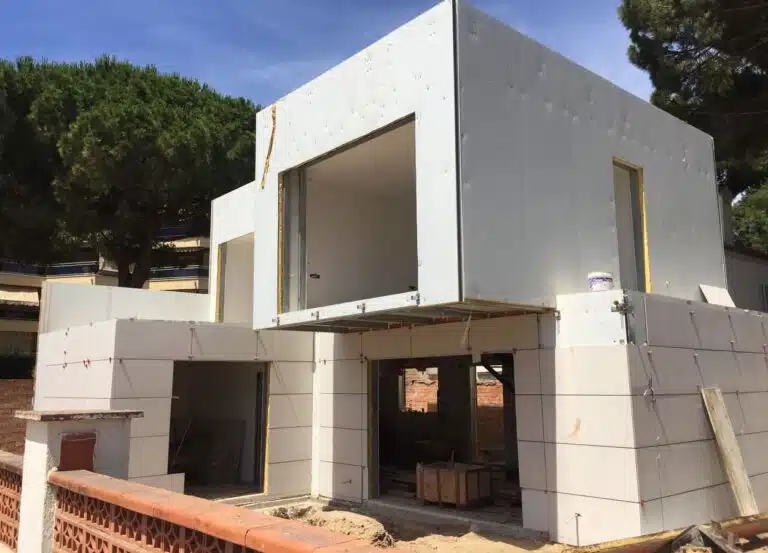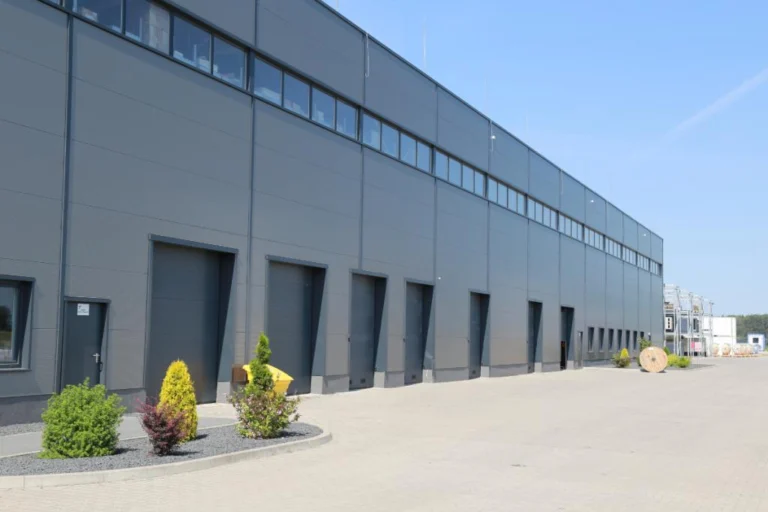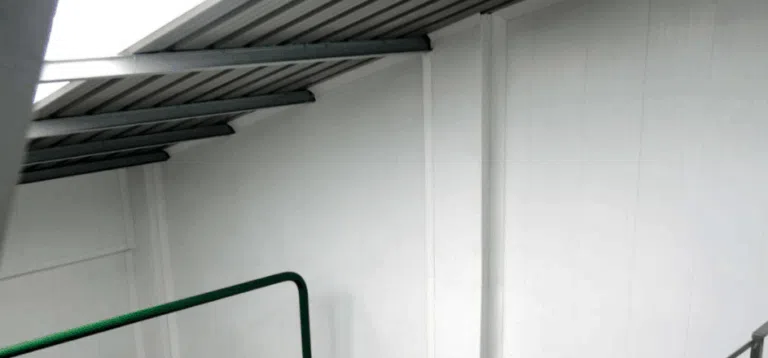
The rock wool sandwich panel is a panel made up of two steel sheets and a rock wool core, a mineral fiber of volcanic origin. It is the panel you need if you are looking for a fireproof enclosure: rock wool is non-combustible, does not spread fire and also provides very good noise insulation.
Looking for pricing or specific models? You’ll find them all in rock wool sandwich panel.
It also insulates against cold and heat, although polyurethane insulates slightly better at the same thickness. That is why it is chosen especially when fire safety or acoustic control are paramount: roofs and facades of industrial buildings, machine rooms, workshops, fire compartmentalization, and public buildings. In this guide, we explain what it is, what fire classifications it has, what thickness to choose, and what to consider during installation.
What is rock wool sandwich panel and how is it manufactured?
It is a three-layer panel. The two outer layers are cold-rolled, galvanized, and pre-lacquered steel sheets. Their multi-layer coating protects the sheet from corrosion, wear, and solar radiation. The color of each side can be chosen from the RAL chart.
The core is compressed mineral wool made from basalt fiber. That is why you will also see it referred to as a mineral wool sandwich panel or slab. This is how it is manufactured:
- Volcanic rock is melted at high temperature.
- The molten mass is converted into fine fibers, oriented in all directions, forming a wool blanket.
- The blanket is compacted and polymerized until a rigid slab is obtained.
- The slab is adhered between the two sheets, which give the assembly its structural stability.
Is it fireproof? Fire behavior
Yes. Rock wool is a non-combustible material: it does not burn or spread flames. The fiber withstands very high temperatures, around 1,000 °C. In a fire, the panel acts as a passive barrier, delaying the spread of fire and allowing time for evacuation. That is why it is the usual choice when a fireproof panel or a fire-resistant panel is sought.
Reaction to fire and fire resistance
These are two different concepts. It is advisable not to confuse them when asking for a quote:
- Reaction to fire: indicates how much the material contributes to a fire. Rock wool panels usually achieve an A2-s1,d0 classification.
- Fire resistance (RF): is the time, in minutes, that the panel withstands without collapsing in case of fire. Depending on the model and thickness, rock wool panels are offered with REI classifications from 30 to 120 minutes.
The exact classification depends on the model, thickness, and how it is installed. Always ask for the technical data sheet and certificate of the specific panel, especially if the project has compartmentalization requirements.
Compared to plastic cores, the difference is clear. Polyurethane and polystyrene are combustible. PIR improves the behavior of polyurethane, but does not achieve the incombustibility of rock wool. If you want to delve deeper, see how polyurethane sandwich panels behave in fire.
Acoustic insulation: the other strong point
The fibrous structure of rock wool breaks sound waves and dissipates their energy. Thus, noise penetrates the enclosure much less. Acoustically, it is far superior to polyurethane. Depending on the thickness and installation, attenuation can be around 35 dB.
It is the typical solution for:
- Machine and compressor rooms.
- Workshops and factories with noisy machinery.
- Sports facilities, educational centers, and venues with large audiences.
- Homes or offices near roads or other noise sources.
For the insulation to work, use appropriate fasteners that hold the panel securely without creating acoustic bridges. If you are concerned about noise in walls and facades, check out the acoustic rock wool panel for facades.
Micro-perforated version
In the micro-perforated panel, the inner sheet has small holes. Sound enters, the wool absorbs it, and it does not bounce back. This reduces reverberation inside the premises, which is useful in large spaces or those with a lot of internal noise.
Acoustic sandwich panel: models and data
The acoustic sandwich panel is a rock wool panel with a perforated inner sheet. It does two things: it blocks noise from entering or leaving (insulation, Rw) and absorbs sound inside the room to prevent echo (absorption, αw). Data from the technical data sheets:
| Model | Rw Insulation | Absorption | Thicknesses |
|---|---|---|---|
| Acoustic for roofs | 34 dB (50 mm); more at greater thicknesses | αw = 1.00 · class A | 50 to 120 mm |
| Acoustic for facades, visible fixing | 34 dB (50 mm) to 37 dB (120–150 mm) | αw = 1.00 · class A | 30 to 150 mm |
| Acoustic for facades, concealed fixing | 34 dB (50 mm); more at greater thicknesses | αw = 1.00 · class A | 50 to 120 mm |
Which one to choose? If the problem is noise coming from outside (a road, a neighbouring factory), Rw is what matters most: more thickness and well-sealed joints. If the problem is echo inside (sports halls, workshops, canteens), absorption is what counts, and that’s where the perforated face makes the difference compared to a standard rock wool panel.
Thermal insulation, humidity, and durability
- Thermal insulation: reduces heat loss in winter and heat gain in summer. It is a good insulator, but at the same thickness, polyurethane (PUR/PIR) has a slightly better coefficient. If you are only looking for the best thermal insulation for a metal roof with the least thickness, polyurethane performs slightly better. If you also need fire resistance or acoustic insulation, choose rock wool.
- Humidity: rock wool is water-repellent and allows vapor to pass through, but it must be protected by the sheet. If the core gets wet, it temporarily loses properties until it dries. That is why joints, trims, and sealing are key.
- Durability: it is an inorganic material. It does not rot and resists microorganisms and pests. If the outer sheet is well maintained, the insulation lasts for the entire useful life of the building.
- Sustainability: it comes from an abundant raw material, is recyclable, and by insulating, it reduces heating and cooling consumption.
Rock wool versus polyurethane and polystyrene
| Criterion | Rock wool | Polyurethane (PUR/PIR) or polystyrene |
|---|---|---|
| Fire behavior | Non-combustible, does not spread flames | Combustible (PIR improves compared to PUR) |
| Acoustic insulation | Very good | Inferior |
| Thermal insulation at same thickness | Good | Slightly better in polyurethane |
| Weight | Heavier | Lighter |
| Cost | Usually higher | Usually lower |
| When to choose it | Fire, noise, or compartmentalization requirements | Tight budget, no special fire or noise requirements |
In summary: if the budget is limited and you do not need acoustic insulation or special fire resistance, a polyurethane panel may suffice. If there is demanding fire regulations or a noise problem, choose rock wool.
Applications and indicative thicknesses
It is used in both new construction and renovations:
- Roofs of industrial buildings, warehouses, shopping centers, and pavilions. The rock wool panel for roofs has reinforcing ribs that improve its rigidity. It is installed on pitched roofs, respecting the manufacturer’s minimum slope.
- Facades of industrial buildings, logistics centers, offices, and commercial buildings.
- Partitions and interior divisions in industrial buildings, logistics centers, and prefabricated or modular buildings.
- Buildings with strict fire regulations, such as hospitals, schools, and other public buildings.
- Cold rooms and refrigerated warehouses where, in addition to insulation, fire resistance is required.
- Homes in noisy areas or with fire protection requirements.
As a guide, the thickness is chosen according to the use:
| Thickness | Common use | Acoustic insulation |
|---|---|---|
| 50 mm | Office partitions | Medium |
| 80 mm | Building facades | High |
| 100 mm | Machine rooms and cinemas | Very high |
| 120 mm | Compartmentalization of risk areas | Maximum |
This is just a guide. The final thickness depends on the fire, acoustic, and thermal insulation requirements of your project. Confirm it with the panel’s technical data sheet or with our technical team.
Installation: what you should consider
The rock wool panel is installed on a metal or concrete structure, without welding. On facades, it fits with a tongue-and-groove system; on roofs, with an overlap that prevents water and air leaks. The system is similar to a standard panel, but it weighs more than a polyurethane one. Provide adequate lifting equipment and more personnel to handle it.
- Prepare the support. La estructura debe estar limpia, nivelada y sin obstáculos.
- Handle with care. Avoid knocks and deformations. Protect the panels from rain during storage so that the core does not get wet.
- Fix with specific screws. Follow the manufacturer’s instructions. For acoustic installations, use fasteners that do not create acoustic bridges.
- Seal joints and install trims. Masillas y cintas evitan la entrada de agua, aire y polvo.
- Review the assembly. Comprueba juntas, fijaciones y remates antes de dar la obra por terminada.
You have the detailed process in our step-by-step guide to installing rock wool sandwich panels. If you don’t have the structure yet, at starmodul.com you will find custom bolted metal structures.
Custom rock wool panel
At PanelSandwich.ORG, we supply custom-made rock wool sandwich panels, in different thicknesses, finishes, and colors, for roofs and facades. We supply them with trims, screws, and accessories, and with delivery to the site. We help you calculate how many panels and accessories you need. We do not sell online or publish prices: the cost depends on the thickness, meters, finish, and transport, so we calculate it in each quote.
Frequently asked questions
Is the rock wool sandwich panel fireproof?
Yes. Rock wool is non-combustible and does not spread fire. The fire resistance of the panel, in minutes, depends on the model and thickness, so ask for its certificate.
Does it insulate more than polyurethane?
From noise, much more. From cold and heat, they are similar, although polyurethane insulates slightly better at the same thickness.
Is it waterproof?
Rock wool is water-repellent, but it must be protected by the sheet. If the core gets wet, it loses properties until it dries.
Is it useful for insulating against neighbor noise?
Yes. A lining with this panel significantly reduces airborne noise, such as voices or television, coming from the adjoining wall.
Is it difficult to assemble?
It is installed like a standard panel, but it weighs more. You need lifting equipment and more personnel.
How long does it last?
It is an inorganic material that does not rot. With good maintenance of the outer sheet, it lasts for the entire useful life of the building.
Do you have a project with fire or noise requirements? Request a quote or call us at 699 147 762. Tell us the building’s measurements and intended use, and we’ll recommend the right panel and thickness. If you need it, we also handle sandwich panel installation.