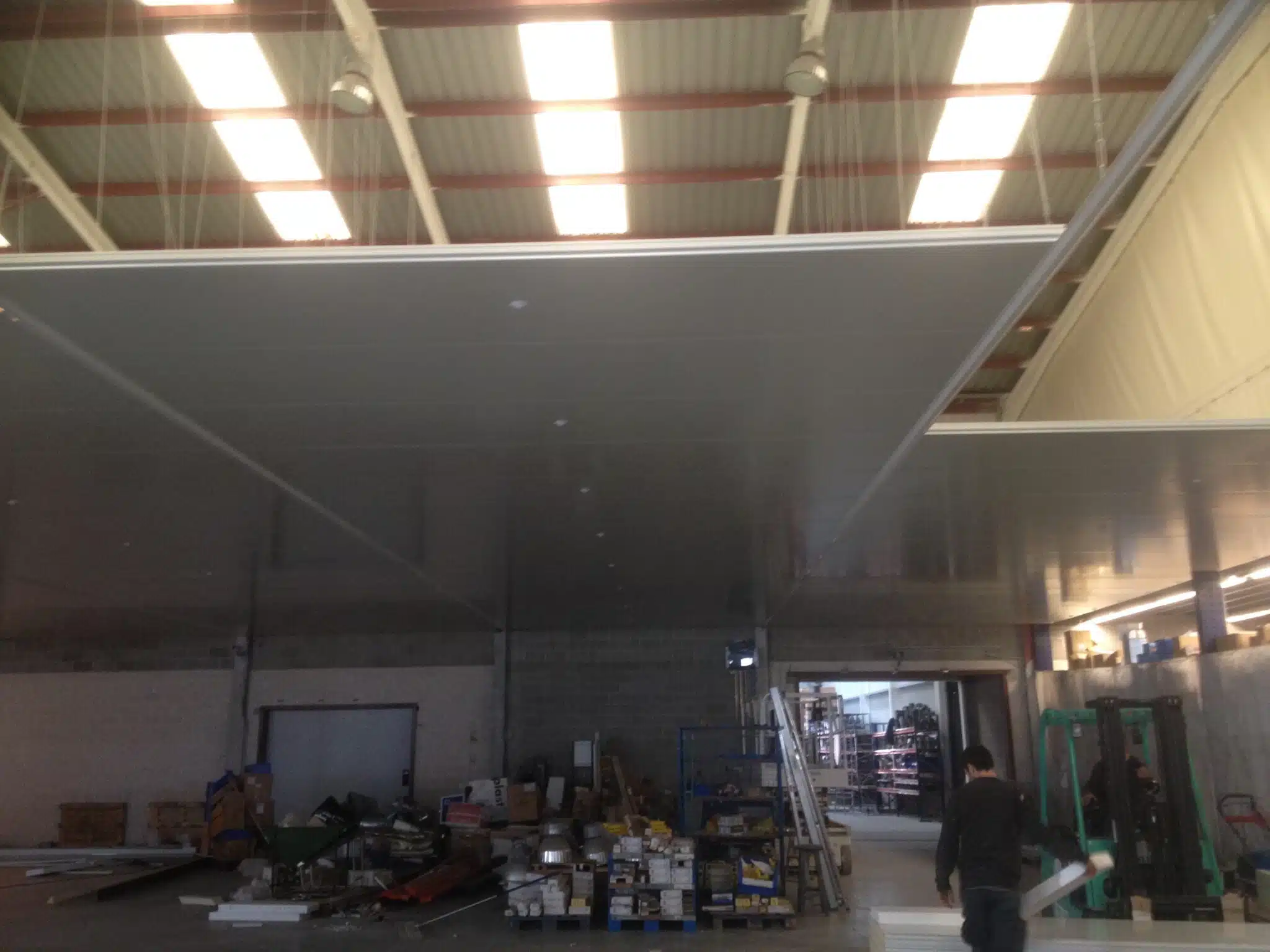
The refrigerated sandwich panel (or cold room panel) is a panel consisting of two galvanized and pre-lacquered steel sheets with a core of rigid polyurethane (PUR) or polyisocyanurate (PIR) foam. It is designed to enclose walls and ceilings of preservation rooms, freezer rooms, food processing rooms, and cold chain warehouses.
Looking for prices or specific models? You’ll find them all under refrigerated sandwich panel.
To make the right choice, you need to look at four things: the temperature you are going to maintain inside, the core thickness, the quality of the joints, and the interior finish. In this guide, we explain each point, the advantages it has over other enclosures, and what to check before ordering your custom-made refrigerated sandwich panel.
What is a refrigerated panel and how is it made
A sandwich panel is a modular element with two outer layers and an insulating core. In the refrigerated version, each part is designed to work with cold and humidity:
- Outer sheets: galvanized and pre-lacquered steel, with anti-corrosive coatings. They provide strength and protect the core.
- Insulating core: high-density polyurethane (PUR) or polyisocyanurate (PIR). This is what stops heat from passing into the interior of the room.
- Tongue-and-groove joints: the panels fit together to form a hermetic seal that limits cold leaks.
- Interior surface: smooth and non-porous, usually in white. It is easily cleaned and disinfected.
The result is an enclosure that insulates, encloses, and provides a finish all at once. You don’t need to add layers of insulation or interior linings.
Preservation or freezing: what each room needs
Not all rooms require the same panel. The main difference lies in the internal temperature and, therefore, the thickness of the insulation.
| Installation | What is stored | What to request for the panel |
|---|---|---|
| Preservation room | Fruit, vegetables, meat, fish, and other fresh products | Standard thickness, good sealing, and hygienic finish |
| Freezer room | Ice cream, deep-frozen foods, and products below -18°C | Greater thickness and very airtight joints |
| Processing room | Food handling areas | Easy-to-clean surfaces and temperature control |
| Cold logistics warehouse | Fresh and frozen products in distribution | Continuous insulation to avoid breaking the cold chain |
For fresh product rooms, you have the preservation refrigerated panel. For sub-zero temperatures, the freezer room panel, with a thicker core.
As a guideline, freezer rooms work with thicknesses from 100 to 200 mm. The exact value depends on the setpoint temperature, the size of the room, and where it is installed. Therefore, it should be calculated for each project.
Advantages of sandwich panels in cold rooms
- High-performance thermal insulation. The PUR or PIR core reduces cold leaks. The temperature remains stable and the cooling equipment works less, which is reflected in the electricity bill.
- Hygiene. The smooth, non-porous surface does not favor the accumulation of bacteria. Additionally, the system reduces visible joints where dirt usually accumulates.
- Fast assembly. The panels are lightweight and fit together via tongue-and-groove. This shortens the work time, lowers labor costs, and facilitates transport.
- Strength and durability. Soportan bajas temperaturas, humedad alta, impactos y los productos químicos de limpieza habituales en la industria alimentaria.
- Adaptability. There are different thicknesses, finishes, and colors. They work equally well for a small restaurant cold room as for a large frozen goods warehouse.
- Expandable rooms. Al ser un sistema modular, el montaje y desmontaje es más sencillo si en el futuro tienes que modificar la cámara.
How to choose the right refrigerated panel
Before requesting a quote, review these criteria. They will help you compare offers with the same level of requirement.
- Temperature and use. Define whether it is for preservation or freezing. The lower the internal temperature, the more thickness you will need. Thicker panels are indicated for deep freezing.
- Core type. Polyurethane (PUR) is the standard option for its insulating capacity. Polyisocyanurate (PIR) also offers better fire performance and more thermal stability. If in doubt, consult the differences between PIR and EPS cores.
- Hermetic joints. A poorly resolved joint is a permanent cold leak. Check that the joining system is airtight and that the junctions with the floor, ceiling, and corners have their flashings.
- Resistance to moisture and corrosion. In a cold room, there is high humidity and frequent cleaning. Request galvanized and pre-lacquered sheet metal with a coating suitable for that environment.
- Regulations and documentation. The panel must comply with the regulations applicable to your activity, both sanitary and fire performance. Request the technical data sheet and product documentation.
- Total cost, not just initial price. A cheaper panel with less insulation can be expensive in terms of electricity consumption. Evaluate the value for money over several years.
Tips to get the most out of your cold room
- Plan the interior. Distribuye estanterías y zonas de carga de forma que el aire circule y se pueda limpiar sin obstáculos.
- Take care of the doors. A good refrigerated door is as important as the panel. If it closes poorly, you lose the insulation you paid for.
- Light it well. Una iluminación LED bien repartida facilita el trabajo diario y ayuda a detectar suciedad.
- Review periodically. El panel frigorífico pide poco mantenimiento, pero conviene comprobar juntas, sellados y golpes en las chapas.
Custom manufacturing, transport, and assembly
At PanelSandwich.ORG, we prepare the refrigerated panel tailored to your cold room. We advise you on the thickness and core, and supply the complete kit: panels, flashings, screws, and accessories. We deliver it to the site and, if you need it, we also handle the assembly.
We work with both small cold rooms for restaurants and shops and with installations for the food, pharmaceutical, and logistics industries.
Frequently asked questions
What is the difference between a refrigerated panel and a normal sandwich panel?
The refrigerated panel is designed to maintain low temperatures: it features a high-density PUR or PIR core, airtight tongue-and-groove joints, and smooth, hygienic faces. A roof or facade panel prioritizes other things, such as water drainage or external appearance.
What thickness does a freezer room need?
As a reference, between 100 and 200 mm. A preservation room can work with less thickness. The final value depends on the internal temperature and the installation conditions.
PUR or PIR for a cold room?
Both insulate very well. PIR provides better fire performance and more thermal stability, something to consider in installations with safety requirements.
Can a sandwich panel cold room be expanded?
Yes. Being a modular system, it can be disassembled and reassembled more easily than a traditional construction enclosure. It is advisable to plan for this in the initial design.
How much does a refrigerated panel cost?
It depends on the thickness, the core, the measurements, and the finish. We do not publish fixed prices because every cold room is different. We will prepare a quote based on your measurements.
Are you going to build or renovate a cold room? Request a no-obligation quote or call us at 699 147 762. We help you choose the right panel and, if you wish, we can install it for you with our sandwich panel assembly service.