PIR sandwich panels provide significantly better insulation than EPS of the same thickness, perform much better in fire, and are more rigid and durable. EPS (expanded polystyrene) is cheaper but requires more thickness to achieve the same insulation and softens or melts with heat. For roofs, facades, and cold rooms, PIR is usually the most balanced option, while rock wool is preferred when fire safety is the top priority.
What is a PIR sandwich panel
PIR (polyisocyanurate) is a rigid foam from the polyurethane family, formulated for better fire resistance. In sandwich panels, it is injected in a continuous line between two steel sheets, to which it adheres. The result is a homogeneous, joint-free core that works together with the sheets to provide rigidity and insulation.
What is an EPS sandwich panel
EPS (expanded polystyrene) is manufactured by expanding polystyrene beads with steam to form blocks. To make the panel, these blocks are cut into sheets and glued to the steel plates. It is a lightweight and economical insulator, but with less insulating capacity per centimetre and poorer performance against heat than PIR.
Differences between PIR and EPS
Thermal insulation
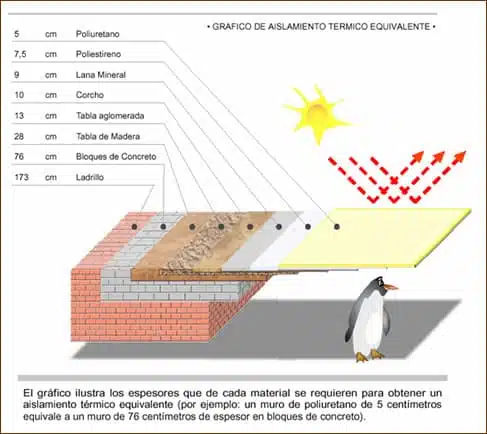
Thermal conductivity measures how much heat a material allows to pass through: the lower the value, the better it insulates. Our panels with PUR or PIR cores have a declared conductivity of 0.0207 W/m·K. EPS is around 0.035 – 0.037 W/m·K, meaning it lets about 70% more heat pass through at the same thickness. In practice, this translates to higher heating and cooling costs.
Required thickness
To achieve the same insulation, an EPS panel must be considerably thicker: a 100 mm PIR panel insulates as much as a 160 mm EPS panel. In a facade, that means gaining about 6 cm of usable space on every wall. If you are unsure about thickness, we explain it in how thick a sandwich panel should be.
Fire Behavior
When exposed to fire, PIR forms a charred surface layer that protects the rest of the foam and slows the flame’s progress. EPS, on the other hand, starts to soften at around 80 – 100°C and melts, causing the panel to lose its core quickly.
Reaction to fire is classified under European standards (Euroclasses). In our panels:
-
•
PUR foam: C-s3, d0. -
•
PIR foam: B-s2, d0. -
•
PIR/HI foam: B-s1, d0. -
•
Rock wool: A2-s1, d0, practically non-combustible, with fire resistance from EI 30 to EI 180 depending on thickness.
Strength and durability
PIR is a closed-cell foam, rigid and well-bonded to the steel sheets, so the panel handles loads better, does not deform over time, and absorbs almost no water. EPS is softer: over time it can detach from the sheet in certain spots, and it is easier for rodents to puncture it and nest inside.
What about PUR? And rock wool?
PUR (polyurethane) is the foam from which PIR is derived. It insulates practically the same, but its fire performance is inferior. PIR is the fire-improved version, and PIR/HI is even more so. If the project demands maximum fire safety, the choice is the rock wool sandwich panel, which is heavier and insulates slightly less per centimetre but does not burn. You can find the full comparison in types of sandwich panels according to their insulating core.
Which one to choose?
-
–
Industrial buildings, warehouses, homes, and offices: PIR. It provides high insulation with low thickness and performs well in fire. -
–
Cold rooms: High-thickness PIR or PUR. You can find the models in refrigerated sandwich panels. -
•
Buildings with high fire protection requirements: rock wool. -
–
Auxiliary constructions with a very tight budget: EPS can be an option, keeping in mind it insulates less and is more sensitive to fire and heat. If you are looking to save, check our cheap sandwich panel options first.
In our metal sheet panels, we work with PUR, PIR, and rock wool cores for roofing, facades, and cold rooms.
Frequently asked questions
Which is better, PIR or EPS panels?
For most uses, PIR: it insulates more with less thickness, is more rigid, and performs much better in fire. EPS only wins on price.
Is the PIR panel fireproof?
It is not non-combustible, but it has a good reaction to fire (B-s2, d0 for PIR and B-s1, d0 for PIR/HI) and forms a charred layer that slows the flame. If you need a non-combustible panel, choose rock wool (A2-s1, d0).
What is the difference between PUR and PIR?
They insulate almost the same. The difference lies in fire safety: PIR is formulated to resist it better than PUR.
How much more expensive is the PIR panel?
It depends on the thickness and model, but the extra cost compared to PUR or EPS is usually offset by energy savings and reduced thickness. You can find guide prices in how much does sandwich panel cost per m²?.
Can mice nest in sandwich panels?
It is easier in EPS because it is soft and easily punctured. PIR is harder and well-bonded to the sheets, making it much less attractive to rodents.
Not sure which core you need? Tell us about the building’s use and we will recommend the right panel and thickness. Request a no-obligation quote or call us at 683 442 608.